Building Fret-o-Matic: The First Sixteen Days
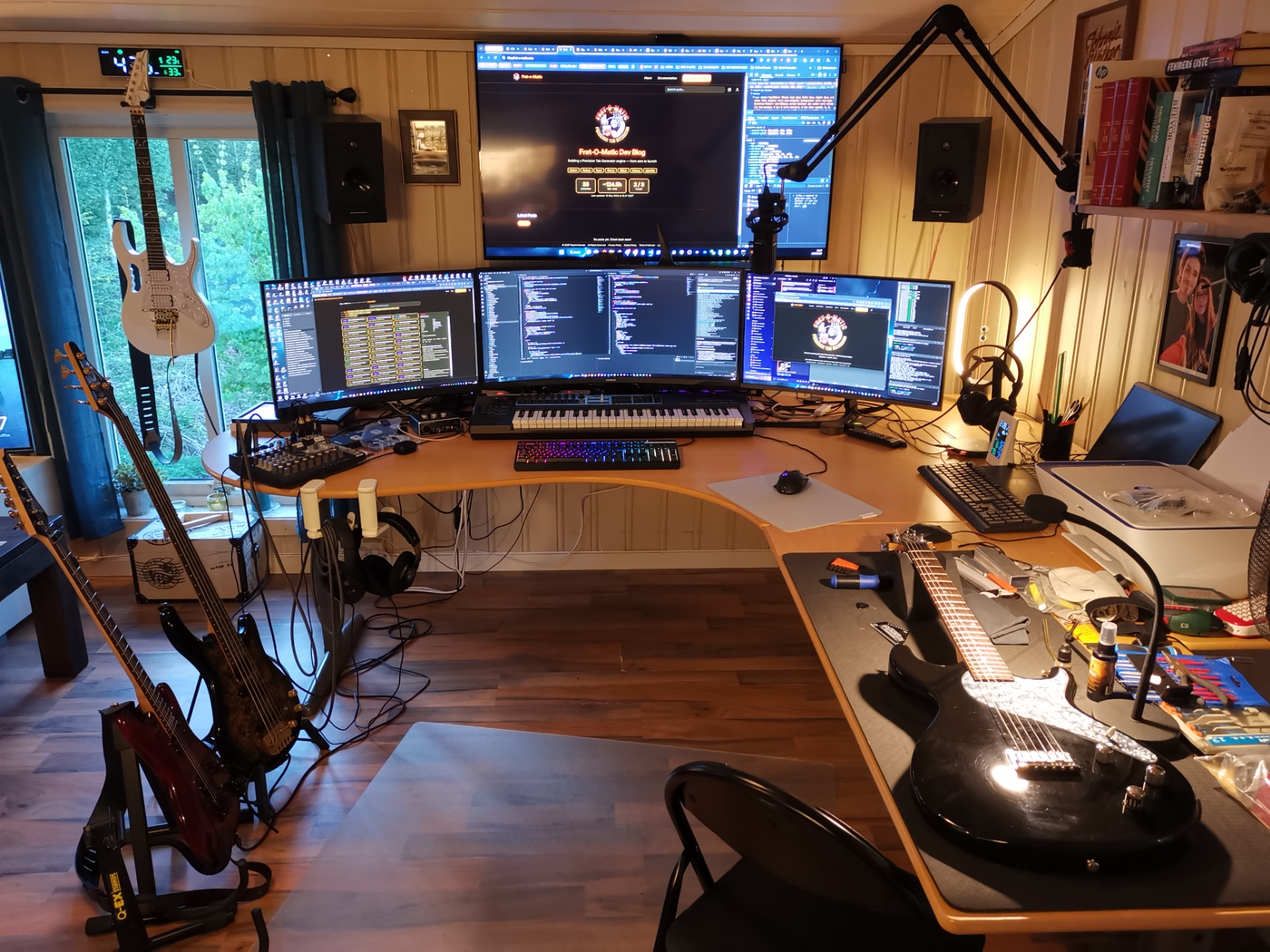
My little music and development studio — in a land far, far away called Norway
It started on a Thursday afternoon with a message I sent to someone else's idea.
May 1st, 2026. Chris Watkins — he runs the production side of Ben Travers' guitar teaching course, My Method — had floated an idea in our Discord server a while back: a DaVinci Resolve plugin that could listen to Ben's guitar parts and automatically generate tab. Auto-transcription, synced to the video, inside the editor.
I'd been thinking about it since he mentioned it. That morning I sent him a message:
"Your idea for a DVR plugin to auto transcribe Ben's guitar parts into tabs is a great idea and absolutely doable."
A few hours later, Cory — "shredmetaldude", our resident lead Discord mod and co-shredding guitarist with an MA in music from the Academy of Contemporary Music — had already weighed in: "If you can crack a way to auto transcribe guitar into tab via audio that's sonically accurate in terms of finger positioning on the fretboard, that's INCREDIBLE and I would keep it a secret."
By early afternoon of that same day, I had built a structured research and proposal document — a full architectural advisory — and sent them the PDF to review. I told Chris and Cory I could build it myself, but I'd need a few weeks for API credits.
That was sixteen days ago. Luckily, I did not have to wait 16 days in order to afford replenishing my API credits to get started for real. Just three days after that first Discord conversation, funding came through from Chris and Ben — they backed the project for real, wiring money to cover cloud infrastructure and the API costs of building at pace. I topped it up from my own pocket when needed to keep the momentum going. With that runway secured, there was nothing stopping me from going full throttle from Day 1. And that is exactly what happened.
How it was possible to develop so much in only sixteen days
The honest answer is that I didn't start from zero.
For several months before May 1st, I'd been building something else entirely — a personal AI system I call HEDDA. It's a completely separate project, not connected to Fret-o-Matic, but building it taught me almost everything that made this speed-run possible.
The governance framework I designed for HEDDA — the structured laws, the documentation standards, the agent hierarchy, the session close protocol — I carried all of that here on Day 1. The Living Documentation System that powers lds.fret-o-matic.com aka LDS is a direct architectural descendant of work I'd done on HEDDA months earlier. The approach to working with AI coding assistants, the way I structure task specs and quality reviews, the discipline of writing a handoff at the end of every session — all of that existed before Fret-o-Matic was a name.
So when I say we had a working audio analysis engine and three live cloud services in sixteen days, I'm not saying I invented everything in sixteen days. I'm saying that months of prior work meant I could move at a pace that would otherwise have taken three times as long.
About Chris Watkins, and why this tool matters
Let me tell you a bit about Chris, because Fret-o-Matic is being built specifically for his workflow.
He's a video editor and cinematographer. He handles all the production for My Method — lighting, audio setup, recording, editing, post-production, all of it. He's been doing video work professionally for years, running Adobe Premiere and Final Cut Pro for most of that time. At some point I mentioned to him that DaVinci Resolve had come a long way since he'd last used it. He made his own call to switch. He's been on Resolve Studio ever since (as far as I know), running it on an Apple Silicon Mac.
My Method is Ben Travers and Chris's joint venture — Ben is the guitarist and teacher, Chris is the person who makes it look and sound professional. The tool I'm building lands squarely in Chris's hands. He's the one in the edit, he's the one who would use a plugin like this on real projects. He's also one of the two people (Chris and Ben) who put money into this, in addition to my own cash contributions to keep developing at a fast pace.
Chris had the original idea. That credit belongs to him. What I did was pick it up, build the plan, and start running. This is a solo development project — which is extremely challenging, but equally fun! Chris and Ben are backing it and eventually testing it. Chris and Cory will help me bullet proof the engine accuracy, while I'm the one building it. Teamwork is the thing that will make this thing fly!
What got built
Here is the short version of sixteen days:
The engine. The core of Fret-o-Matic is a Python audio analysis pipeline. It takes a guitar audio track, detects the tempo, key, beat grid, and note events, and prepares that information for the tab generation stages that follow. The hard research here was done by teams at Spotify and academic music information retrieval groups. I'm standing on their shoulders. The engine is implemented, tested, committed, and documented.
The documentation system. Running at lds.fret-o-matic.com — a private, searchable developer tool which I've built from scratch. It has turned out to be an invaluable developer tool that I'm insanely proud of, but sadly only a select few will be able to interact with it. I might make a public GitHub repo for other developers to customise for their own projects, but that will have to wait until this project is shipped.
The landing page. fret-o-matic.com is live. Clean, consistent with the visual identity, with a Request Access form for the people who are invested in the project, and want to track all the details and project secrets, including my proprietary IP.
This blog. May 9th. I dropped the landing page link in our Discord — told Chris it was a lunch break project, apologised for the tech ranting as per usual. He came back with: "Should do a blog about the build on it? This is fucking awesomeeeee." The next day I asked him: public or invite-only? He said public, so people could follow the journey. I said fine — I just need to filter out the recipe for how to make the thing. The codebase stays our little secret.
A week later, this blog exists. Built entirely from scratch, deployed, running. Another speed run.
What isn't built yet
The plugin itself.
The bridge — the piece of code that actually lives inside DaVinci Resolve, creates the control panel, talks to the engine, and drops the tab overlay onto Chris's timeline — has not been started. Everything so far has been the foundation. The engine that does the hard audio work. The infrastructure. The documentation. The blog.
The plugin is what the next phase is for. When Chris opens Resolve, clicks something, and tab appears on his screen — that's the moment this project becomes real for him. We're not there yet. But the path to it is clearer than it has ever been.
Cory Taylor
Worth mentioning separately. He showed up in the Discord thread on Day 1 and immediately understood what this could be. He's a genuinely skilled guitarist — the kind of player who notices when transcription is wrong by a fret, not just by a position. When the engine is producing output, Cory is going to be the person who tells us whether it's actually right.
That kind of tester is not something you manufacture. I'm glad he's in.
Ben Travers
And finally a HUGE SHOUTOUT to the absolutely amazing and brilliant BEN FUCKING TRAVERS! Without Ben popping into my YouTube feed a year ago or so, I would never have encountered Chris, which resulted in me building Ben's official Discord Server, and I would never have been able to recruit Cory as a Discord mod and tester for Fret-O-Matic. I bow to you, Shreddimus Maximus - as I bow to all of you guys!!! \m/
The paper trail
Every session on this project has a handoff document. What was done, what comes next, what decisions were made. Written at the end of each session, before the session closes.
The posts on this blog are built from those handoffs. Not reconstructed from memory. Derived from structured notes, edited into readable prose, reviewed by me before they go up.
The retroactive posts — covering each day of development from May 1st — will follow this one. This is the overview. The details are coming.
Why document it at all
Because Chris thought it was worth following. Because I think the actual process of building something like this — not a tutorial, not a course, the real thing with real pressure and real money and real people waiting — is worth showing.
And because sixteen days in, I want a record of how this started. With a Thursday afternoon message, a Discord thread, and a PDF nobody asked me to write.
Please forgive me if you find the UI I have designed somewhat lacking... This is work in progress, so I'll obviously make quite a few incremental changes along the way.
Oh, and on a final note... Did I mention that I'm building this stuff for Windows, MacOS AND Linux? Yup, that's how I roll, baby! ROCK'n'ROLL!!!
Written by Torgrim Nyerrød — May 16, 2026
Discussion (0)
Loading comments…